
Start with the actual condition
When the opener raises the door but refuses a closing command, the protective sensor circuit is one place to investigate. Record its behavior without defeating it. A clear account of the lights, controls and time pattern is more useful than an improvised bypass.
Observe without entering the path
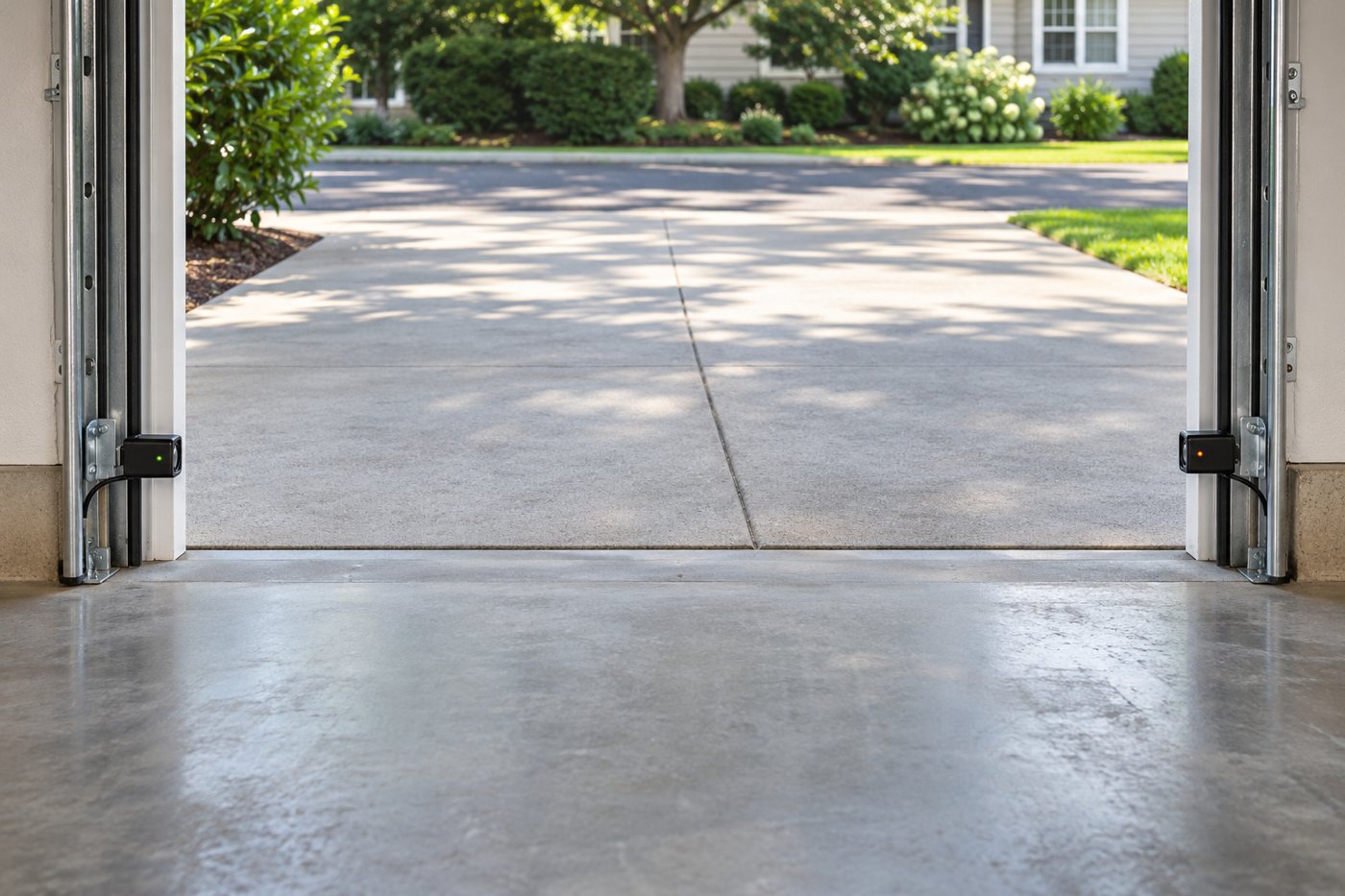
With the system stationary and everyone clear, look for objects near the floor-level beam. Bins, a tool handle, leaves or snow near the opening can interrupt it. Notice whether a lens is dirty or a bracket appears to have been bumped. Do not loosen track hardware while investigating.
Read the actual manual for the model. Sensor light colors and diagnostic flashes vary. A code remembered from another opener may be misleading. Save the model and the observed sequence so the technician can interpret the correct instructions.
Build a short symptom record
| Question | Observation to keep |
|---|---|
| Does the fault happen all day? | Continuous or limited time window |
| Do both controls fail? | Remote, keypad and wall-control behavior |
| What do the sensors show? | Steady, blinking or unlit indicators |
| Has something moved nearby? | Storage, bracket impact or visible wire damage |
| Does the door travel squarely? | Any tilt, scraping or mechanical obstruction |
A sensor indication does not rule out another fault. A door can have damaged wiring and a worn roller at the same time. If there is uneven movement, slack cable or a spring warning sign, stop normal use and report that first.
Low sun can be relevant
The angle of Front Range sunlight changes through the year. Chamberlain Group documents light interference on some receiving sensors. Note the time and which side of the opening receives direct light, without treating sunlight as the diagnosis in every case.
An approved shield or revised arrangement must preserve the safety beam and follow the manufacturer instructions. Do not tape over a lens, block the sensor or install a makeshift device to keep using the door. Safety protection is part of the operating system.
Keep the motor decision separate
A clean lens and clear path do not prove that the logic board, wiring or safety circuit is sound. Conversely, a closing refusal does not automatically require a new opener. Ask for the diagnostic basis before choosing replacement equipment.
Repeated cycles are unhelpful when the door is binding or unstable. Increasing force to overcome resistance can add damage and risk. If the opening cannot be secured safely, describe the position during the call and keep people away rather than experimenting beneath it.
Verify the correction
After the work, the system should be checked through its travel and the safety procedure specified for the model. Keep the manual and note the original fault. A recurring time-of-day pattern is useful follow-up information if the behavior returns.
Arrange garage door opener repair for diagnosis. If the system requires replacement, opener installation planning covers mounting and controls. The coverage directory lists the exact ZIP footprint for the Denver area.
Technical references and next steps
Consult the DASMA garage-door safety guidance and CPSC opener safety information, together with the actual equipment manual. For sunlight-specific sensor behavior, see Chamberlain Group support.
Call with the door position, observed symptom and postal ZIP. Local scope and scheduling are confirmed by phone. Keep people clear of a visibly damaged or suspended door.