
Start with the actual condition
If a door suddenly becomes heavy, stop treating it as a motor-power problem. The springs counterbalance the assembly. A failed spring or related lifting fault can leave the door unsafe to move even when the electronic controls still respond normally.
Describe what happened, in order
A sharp bang, a visible separation in a coil and a door that barely lifts form one common warning pattern. An uneven start or slack cable is also relevant. Say whether the opener was used after the change and where the door is now resting.
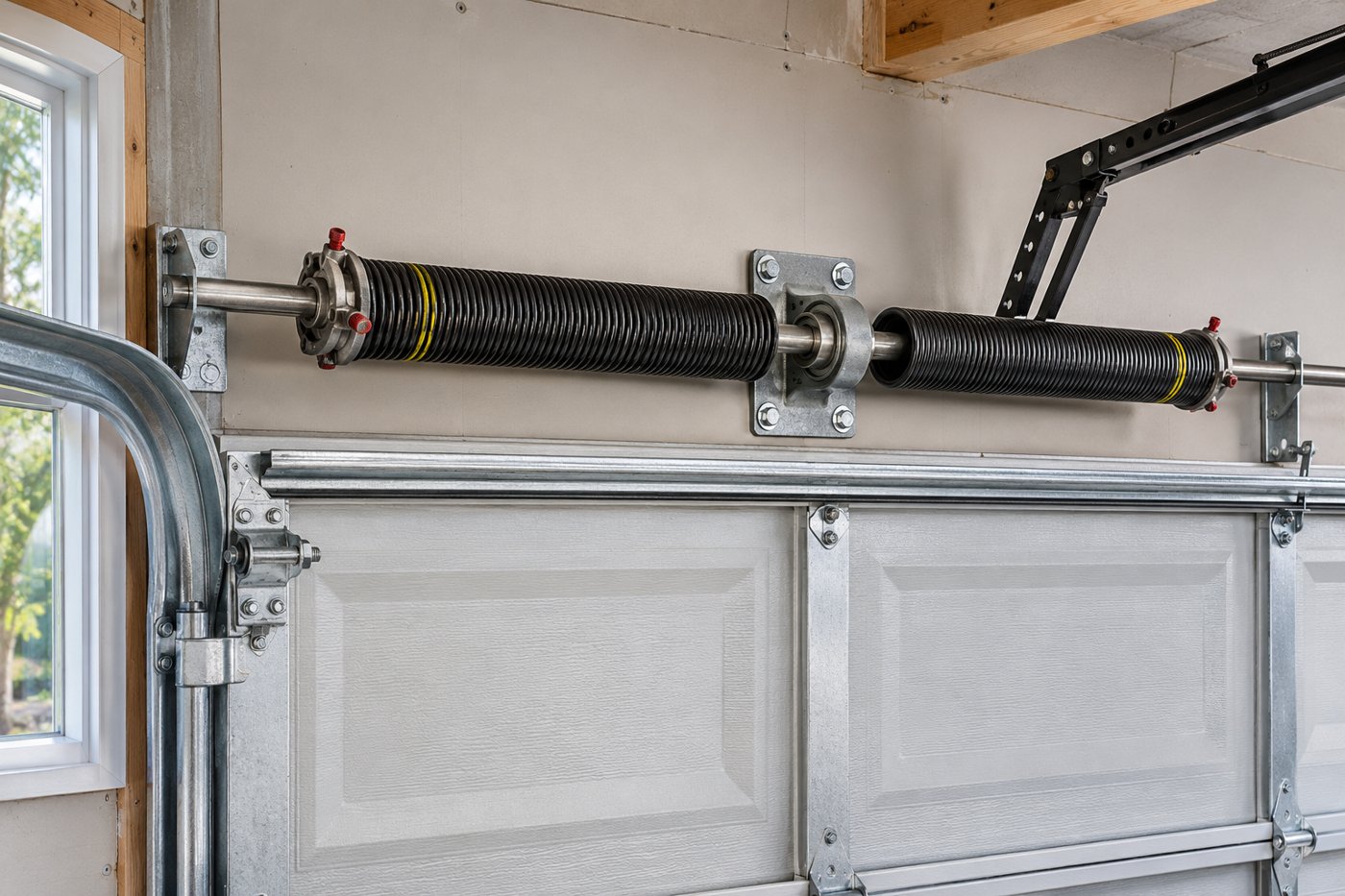
Not every door uses the same spring layout. Torsion systems commonly have a shaft above the opening; extension systems are arranged along the tracks. Do not touch or dismantle the system to identify it. A safe photograph may help, but inspection and load control remain professional tasks.
Keep the door where it is safely controlled
Do not unwind a spring, loosen a drum or remove a bottom bracket. These connected components may carry stored tension. Do not attempt to lift a heavy door alone or ask the opener to pull harder. Clear people, animals and vehicles from the opening without going beneath the door.
An emergency release is not a general rescue handle. A raised door with weak or broken springs may fall when disconnected. Tell the technician if the door is partly open, particularly if a vehicle is trapped below it. Avoid improvised supports and leave load control to trained personnel.
Ask how the replacement is specified
| System detail | Why it belongs in the assessment |
|---|---|
| Door weight | Establishes the counterbalance needed |
| Door dimensions and lift | Affects travel and lifting geometry |
| Spring arrangement | Determines compatible components |
| Cable and drum condition | Can affect even lifting and control |
| Anchor and bearing condition | Supports the working assembly |
A part color or an old online order does not prove that the spring is correct. Previous panel changes can alter weight, and an earlier repair may have used an unsuitable part. Ask how the door will be matched and checked.
Look at the connected system
A new spring does not resolve a damaged cable, worn bearing or insecure anchor. The scope should explain what else has been inspected and whether a paired arrangement is being evaluated. A cable that slipped off a drum should not simply be pushed back by the homeowner.
Once mechanical balance is established, the operator and safety functions can be checked according to the equipment instructions. Increasing motor force to conceal resistance leaves the underlying problem unresolved.
Cold weather is context, not proof
If the failure occurred on a cold morning, mention that along with the actual symptoms. Temperature alone does not establish why a spring failed. Likewise, a bottom seal frozen to the floor can create resistance without proving a broken spring. Do not force either condition.
Use garage door spring repair to discuss the assessment. Read winter access care for threshold observations after the door has been confirmed sound, and check your covered ZIP during the first call.
Technical references and next steps
Consult the DASMA garage-door safety guidance and CPSC opener safety information, together with the actual equipment manual. For sunlight-specific sensor behavior, see Chamberlain Group support.
Call with the door position, observed symptom and postal ZIP. Local scope and scheduling are confirmed by phone. Keep people clear of a visibly damaged or suspended door.