
Start with the actual condition
Cold-weather access starts with a clear, safely controlled opening. Snow, ice and a worn bottom seal can affect operation, while an existing mechanical fault can appear at the same time. Keep those possibilities separate before asking a motor to move a resistant door.
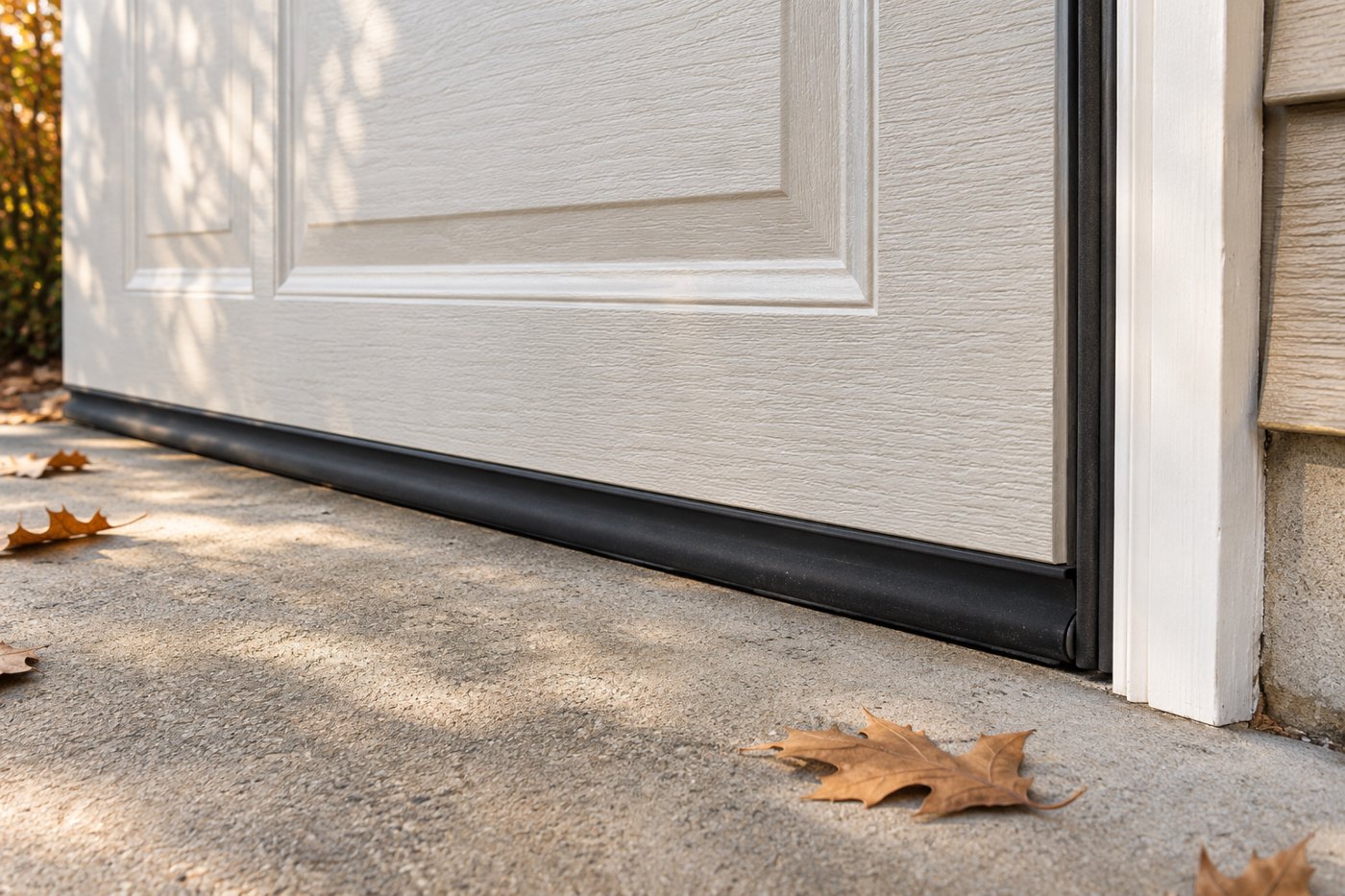
Look at the bottom edge first
When the door is fully closed and stationary, observe the threshold from outside the travel path. Is snow piled against it? Is the lower seal apparently bonded to the slab? Is there an uneven gap at one corner? Record what is visible without putting fingers or tools beneath the door.
Do not use repeated opener commands to pull a frozen seal free. The operator may strain against the obstruction, affecting the drive or upper door section. Stop and arrange an appropriate assessment rather than assuming more force is the answer.
Distinguish fit from wear
| Observation | Question for the assessment |
|---|---|
| Torn or hardened lower seal | Which retainer/profile fits this door? |
| Uneven daylight at the floor | Threshold shape, door alignment or both? |
| Scraping during travel | Where does it start and is the door square? |
| New motor strain | Is the door obstructed or unbalanced? |
| Visible cable damage | Stop use and arrange mechanical inspection |
A larger seal is not a cure for an out-of-square assembly. A new opener is not a cure for a broken spring. Ask for the cause to be explained rather than combining unrelated replacement parts into one assumed fix.
Keep routine care model-specific
Use the door and operator instructions for approved owner maintenance. Keep accessible sensor lenses and the beam path clean. Avoid filling tracks with grease; collected debris can complicate travel. Only apply the specified product at the permitted points.
Spring tension, cables, bottom brackets and force adjustments belong with trained service personnel. If the door has become unstable, pause routine care and request repair assessment. An owner check is intended for an otherwise sound system.
Record the weather pattern accurately
Note whether the failure appears only on a freezing morning, after snow reaches the threshold or at a low sun angle. Does it continue when conditions change? That record guides diagnosis without claiming that temperature explains every failure.
For a garage connected to a living area, discuss seals, walls and normal ventilation together. Insulation labels apply to defined products or assemblies, not the final temperature of every garage. The building and how often the door opens also matter.
Plan a safe service conversation
Keep a clear approach and an alternate entrance where possible. Mention a shared alley, restricted gate or a vehicle inside the garage. Give the postal ZIP early; Denver and Littleton mailing labels alone do not establish the eligible footprint.
Use maintenance and tune-up assessment for a stable system needing attention. A sudden heavy door belongs with spring assessment, and an opener that refuses closing commands may need sensor diagnosis. Calls and repair requests are accepted 24/7; actual local scheduling is confirmed by phone.
Technical references and next steps
Consult the DASMA garage-door safety guidance and CPSC opener safety information, together with the actual equipment manual. For sunlight-specific sensor behavior, see Chamberlain Group support.
Call with the door position, observed symptom and postal ZIP. Local scope and scheduling are confirmed by phone. Keep people clear of a visibly damaged or suspended door.